
The first step to overcoming your weaknesses is to acknowledge and name them. For me, I know I struggle with public speaking. While my diploma thesis was solid and my source code wasn’t bad at all, the way I presented them to the committee—the people who held the “Yes” or “No” to my degree—was far from what I’d call a “decent presentation.” To put it bluntly: it certainly wasn’t my best performance; in fact, it was probably close to my worst.🙂
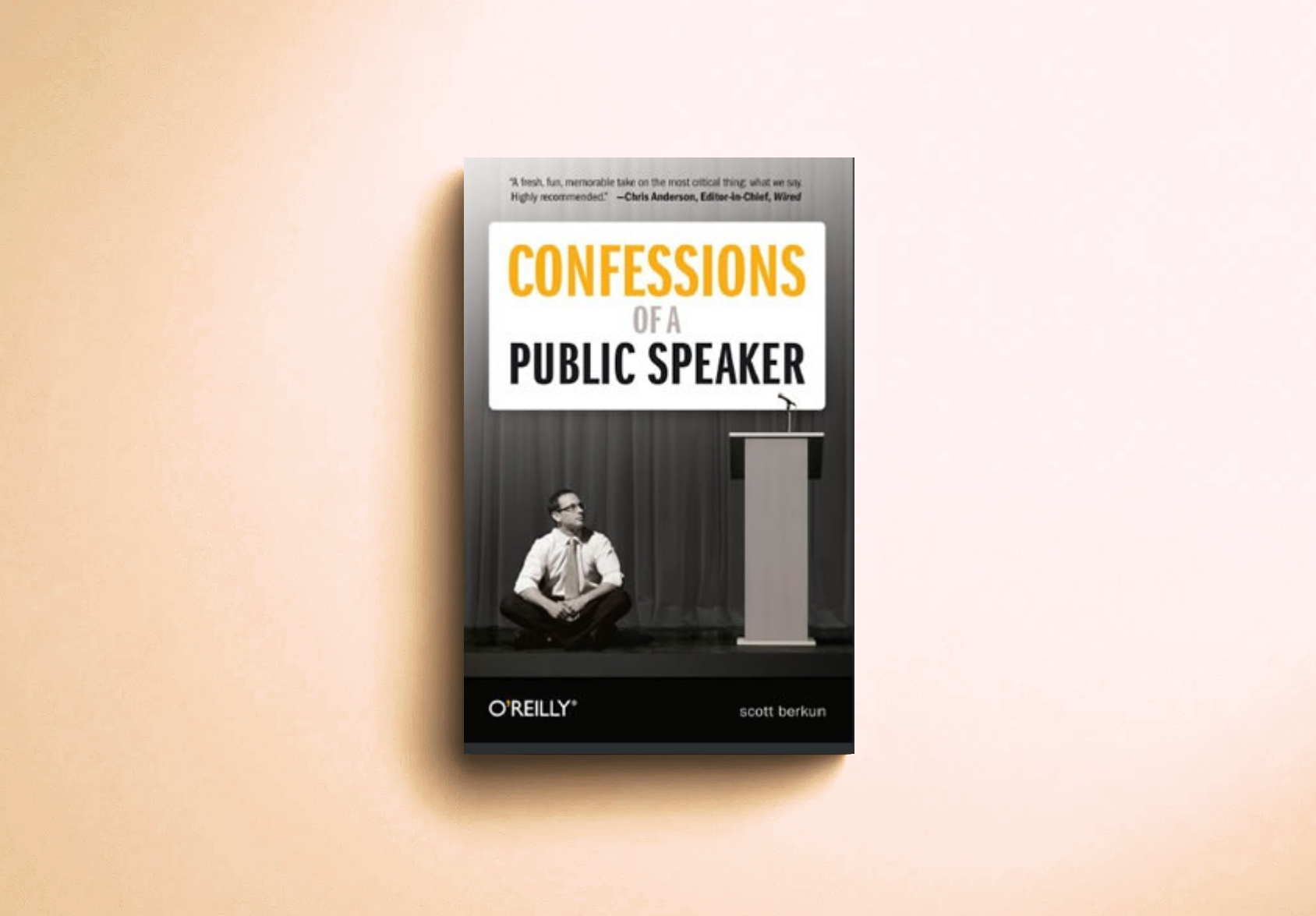
And that’s why I recently bought an interesting book “Confessions of a Public Speaker” by Scott Berkun.
The most important thing to know before you even consider buying this title is this:
Reading this book will NOT make you a better speaker, only practice can do it.
However, this book will tell you why you should practice, what you should practice, and how to prepare for a speech to maximize your chances of performing well.
Why We Hate Public Speaking
Scott Berkun explains that for thousands of years, our brains have been conditioned to understand that:
Four things very bad for our survival are:
- Standing alone
- In open territory with no place to hide
- Without a weapon
- In front of large crowd of creatures staring at you
Because of this, it is impossible to feel completely relaxed when our minds perceive our position as a threat. We simply need to learn how to handle that stress effectively. Even world-famous performers (like Bono from U2) experience stage fright; they have simply learned how to maintain control in front of a crowd.
Berkun provides numerous useful tips on how to “suck less” at public speaking. I will highlight a few here, but the book is packed with many more. If this post resonates with you, you should definitely consider picking up a copy.
Tips and Tricks for Public Speakers
- Never plan to use your full allotted time. Always save 10–20% as a safety buffer. This ensures you won’t struggle to cram in material if the person before you goes over time or if the audience interrupts with questions.
- Avoid the mistake of trying to be perfect. You will make mistakes. Practice as much as you can, but be prepared for slip-ups and don’t panic when they happen.
- Your reaction defines the audience’s reaction. If you take a mistake lightly, the audience will too.
- Consolidate your audience. If you are speaking in a large room to a small group, ask them to move closer together. It is much easier to connect with a focused group than to speak to a sea of empty chairs.
- Master your transitions. Prepare your talk so that the conclusion of one slide naturally introduces the next. This makes your “story” feel fluent and consistent.
- Involve the audience. Ask about their experiences or have them raise their hands. Give them a problem to solve, such as: What would you do if your office lost internet access the day before a deadline? Interaction keeps people engaged.
- Use a confidence monitor. If possible, set up a monitor visible only to you that mirrors your slides. This prevents you from turning your back on the audience to check the screen.
- Invest in a remote clicker. This frees you from your laptop/podium and allows you to move to the best spot on the stage.
- Use a timer. Track your progress and adjust your pace early if a section is taking longer than planned.
- PRACTICE. Practice in front of a webcam, practice for your partner, or practice for a friend. PRACTICE, PRACTICE, PRACTICE!
Summary
I found Confessions of a Public Speaker to be a fascinating guide to giving successful presentations. Beyond the practical hints, it leaves you with the comforting realization that public speaking isn’t as fearsome as you once thought. That shift in perspective alone makes it worth the read.
Scott Berkun – about the author:
- website: http://www.scottberkun.com/
- blog: http://www.scottberkun.com/blog/
- X/Twitter: http://x.com/#!/Berkun